What a Broken Key Extraction from a Fultondale Storefront Deadbolt Actually Looks Like, Tools, Time, and Next Steps
Last updated: September 20, 2026
Published September 21, 2026 · Updated September 21, 2026
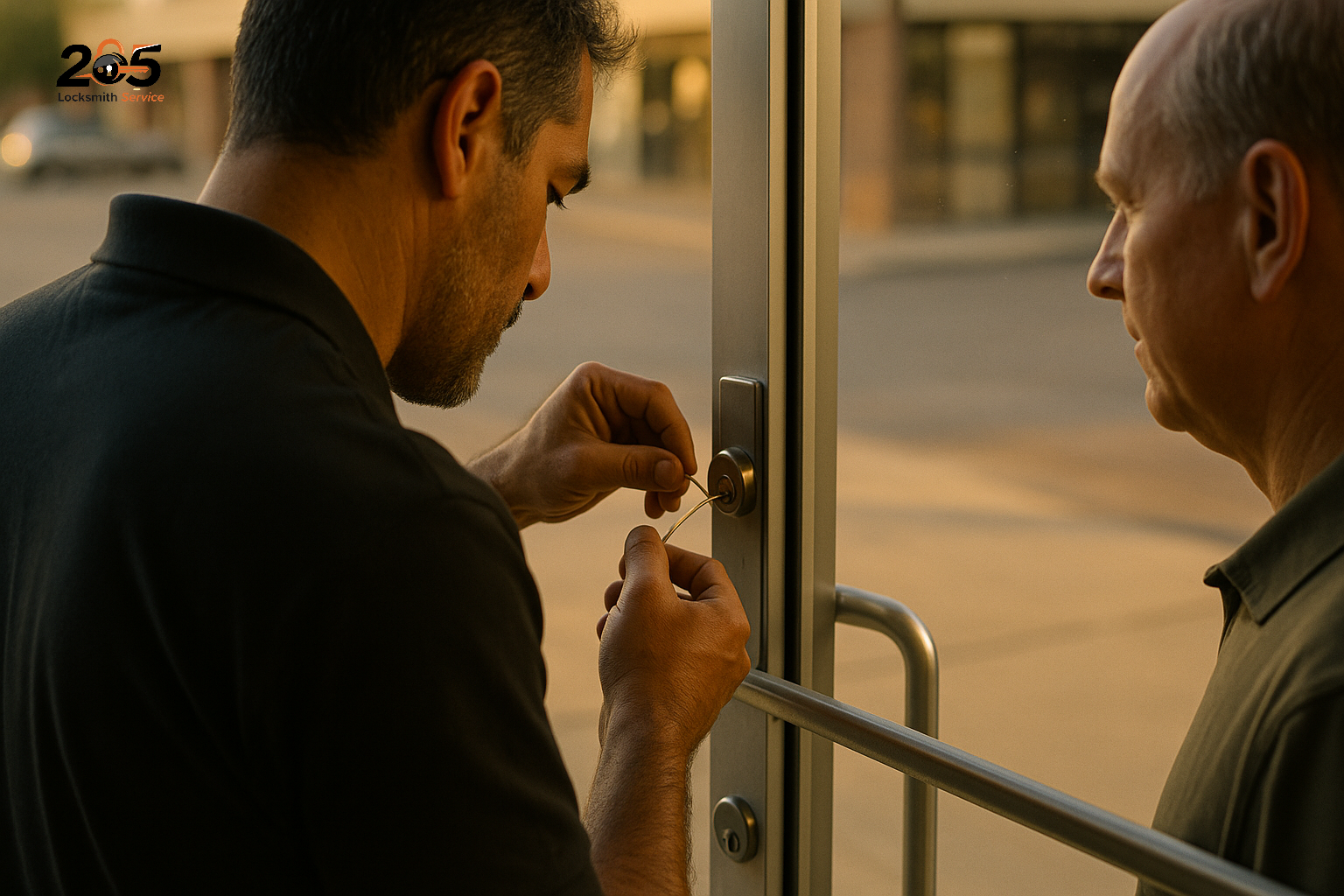
A broken key extraction commercial deadbolt storefront Fultondale Alabama locksmith process starts with one thing almost nobody expects: we do not touch the key first, we check whether the plug is still square in the cylinder. A clean extraction with a spiral or sawtooth extractor usually takes minutes on site and leaves the Schlage, Yale or ASSA ABLOY cylinder fully reusable. The broken key is rarely the real problem. A binding bolt, a sagging storefront door or a strike that drifted out of alignment is what snapped it.
- A broken key extraction from a commercial deadbolt is usually a minutes-long job on site, not a lock replacement, as long as nobody has already glued, drilled or pried the cylinder.
- Brass keys work-harden after years of duplication, and a duplicate cut from a duplicate is thinner than the original, which is why the failure almost always happens at the shoulder or the first cut.
- ANSI/BHMA Grade 1 deadbolts (the commercial standard, with a 1-inch throw bolt) are built to survive this, so the cylinder generally does not need replacing after a clean extraction.
- WD-40 and superglue are the two most expensive mistakes we see on storefront locks, because one packs the pin chambers with grit and the other can bond the plug to the shell.
- Restricted keyways such as Medeco and Mul-T-Lock require authorized blanks and signature-card verification, so extraction and key replacement are two separate conversations on those storefronts.
- 205 Locksmith Services is mobile across the Greater Birmingham area 24/7, including Fultondale, Gardendale and Center Point, and you get the complete quote on the phone before a locksmith is dispatched.
The Broken Key Extraction Process for a Commercial Deadbolt in Fultondale
The broken key extraction process for a commercial deadbolt in Fultondale runs in a fixed order: assess the plug position, confirm how much fragment is exposed, choose the extractor, pull the fragment, then test and diagnose why it broke. Skipping the last step is how a business gets a second broken key three weeks later.
If you manage a storefront in Fultondale and the key just snapped at open, this is written for you, not for someone reading about a house key in a Kwikset knob lock. Commercial deadbolts behave differently. They are heavier, the bolt throw is longer, and they are mounted in doors that move with the weather.
Fultondale sits along the I-65 corridor north of Birmingham, and the retail doors here take the full Alabama swing: humid mornings, hard afternoon sun on a dark metal frame, then a cold snap in January. Steel and aluminum move. The strike does not move with them. That is the whole story behind most snapped commercial keys we pull.
What We Found
On a job like this the first observation is where the break happened on the blade. A key that snaps right at the shoulder, where the blade meets the bow, is a fatigue break: that section flexes every single time someone turns it, and brass work-hardens until it gives. A key that shears mid-blade, across the cuts, means somebody applied real torque against a bolt that would not move.
Second observation: the plug position. If the fragment broke while the cylinder was partially rotated, the plug is off center and the keyway is no longer lined up with the shell. You cannot slide an extractor past that. The plug has to be rotated back to the 12 o’clock rest position first, gently, usually with a thin tension tool riding the fragment.
Third, and this is the one owners never expect us to look at: the bolt and the strike. We watch how the deadbolt throws with the door open versus closed. If it throws smooth in the air and drags when the door is shut, the lock is fine. The door dropped, or the frame shifted, and the bolt is scraping the strike plate lip on the way in. The key was just the weakest part of the chain.
Honestly, the first few years in this trade we would pull the fragment, cut a new key, and roll out feeling good about a fast job. Then the callbacks taught us better. A grinding key is a warning, and it was almost always ignored for weeks.
| What the break looks like | What it usually means | Tool we reach for |
|---|---|---|
| Fragment sticking out past the cylinder face | Clean snap at the shoulder, metal fatigue on an old duplicate | Fine needle-nose pliers, straight pull with no twist |
| Fragment flush with the face | Broke under torque, plug may be rotated off center | Spiral extractor plus a thin hook to lift the blade |
| Fragment sunk below the face | Someone already tried to push it in or pick around it | Double-barb sawtooth extractor, worked along the cut edge |
| Fragment will not budge, plug feels gritty | Penetrating oil or graphite overload packing the chambers | Cylinder removal, bench work, full clean and re-pin |
| Bolt drags when the door is closed | Door sag or strike misalignment, the real root cause | Strike adjustment, hinge check, closer tension check |
How We Solved It
Here is the sequence a licensed and insured locksmith follows on a broken key extraction from a commercial deadbolt at a Fultondale storefront. Every step is damage-free until damage is the only option left, and it almost never is.
Inspect before touching anything
A light into the keyway shows how deep the fragment sits and whether the plug is square. We also ask for the broken half still in the customer’s hand, because it tells us the blank and the cut pattern.
Return the plug to rest position
If the cylinder is rotated, a thin tension tool nudges it back to 12 o’clock so the keyway lines up with the shell. Force here is how a cheap job turns into a drilled cylinder.
Add a dry lubricant, never a wet one
A puff of dry PTFE or a controlled trace of graphite reduces friction on the fragment. Oil-based sprays attract the red dust and pollen that coat every north Birmingham storefront lock.
Set the extractor along the cut edge
A spiral extractor threads into the blade material, a sawtooth extractor bites the valleys of the cuts. On a six-pin commercial keyway we often run two extractors in tandem to keep the fragment from cocking sideways.
Pull straight out, with the pins relieved
Slight upward pressure lifts the bottom pins off the blade while the extractor walks the fragment forward. You feel it release. It sounds like nothing at all, which is the point.
Cut a fresh key, ideally to code
We reassemble the two halves, gauge the cuts, and cut a new key on a correct blank from the van. Cutting to the original code beats copying a worn key, because a copy of a copy is what broke in the first place.
Fix the reason it broke
Strike plate adjusted, mounting screws checked, closer tension verified, bolt throw tested with the door shut. If the deadbolt cannot throw its full inch without drag, the job is not finished.
What This Means for Fultondale Storefront Owners and Property Managers
For the property manager juggling three retail units on the north side, the lesson from this job is that a broken key is a maintenance signal, not bad luck. The key snapped because the door had been getting harder to lock for weeks and everyone leaned on it a little harder each morning. The hardware told you. Nobody was listening.
The second lesson is about the keys themselves. Brass duplicates get thinner and more brittle every time they are copied off another copy, and a storefront key that four employees have all had cut at four different counters is a fatigue failure waiting to happen. Cutting fresh keys to the original code, or moving the storefront onto a controlled key system, ends that cycle. That is also the moment to talk about a proper commercial locksmith and master key system setup so one key does not have to do six jobs.
Third: what you do in the ten minutes after the break decides whether this is a small job or a big one. Do not push the fragment deeper trying to get a look at it. Do not spray a can of penetrating oil in there. Do not glue anything to anything. We have removed cylinders that were completely serviceable until superglue reached the pin chambers, and that is a bench rebuild instead of a quick pull.
A broken key in a Fultondale storefront deadbolt is usually recoverable without drilling if the cylinder is left alone until a locksmith arrives. Untouched cylinders come apart clean. Cylinders that have been oiled, glued or pried usually need to be pulled and rebuilt on the bench, and that is a different job entirely.
When the keyway is restricted
If the storefront runs Medeco or Mul-T-Lock, extraction and replacement are two separate matters. Those systems use patented, restricted blanks that are only issued to authorized parties, usually against a signature card held on file. We can pull the fragment and get you open the same visit, but the replacement key follows the key control rules that the system exists to enforce. That is a feature, not an obstacle. It is exactly why the lock is harder to copy at a kiosk.
Standard commercial keyways from Schlage, Yale and other ASSA ABLOY lines are more forgiving: the blank is stocked on the van and the new key is cut on site. Choosing between entry-grade, mid-range and high-security-grade hardware for a retail door is a conversation worth having before the next failure, and it is part of how we approach lock installation and lock replacement for commercial doors.
Our Take After Years of Commercial Lock Work Around Birmingham
Business owners overweigh the lock brand and underweigh the door. We see Grade 1 deadbolts from good manufacturers failing early in strip retail because the door itself sags, the closer is cranked too tight, or the frame took a hit from a delivery cart and nobody adjusted the strike afterward. A high-security cylinder bolted into a door that does not line up is an expensive way to keep breaking keys.
What actually matters, in order: the bolt throws freely with the door closed, the keys in circulation are cut to code rather than copied off each other, and somebody at the business owns the key control. That last one is the quiet failure in most small retail operations. Six people have keys, two of them left last year, and nobody is certain who still has what.
The one thing we would tell a friend running a shop in Fultondale: the morning your key starts needing a wiggle is the morning to call, not the morning it snaps with customers in the parking lot. 205 Locksmith Services is family-owned, licensed and insured, mobile across the Greater Birmingham area 24/7, and you get the complete quote on the phone before a locksmith is dispatched. If you are already locked out, our 24/7 emergency lockout service covers business doors as well as homes and vehicles.
FAQ: Broken Keys in Commercial Deadbolts
Can a broken key be extracted from a commercial deadbolt without replacing the whole lock?
Broken key extraction from a commercial deadbolt almost always saves the existing lock, including ANSI/BHMA Grade 1 cylinders from Schlage, Yale and other ASSA ABLOY brands. Extraction tools work inside the keyway and do not damage the plug, shell or pins. Replacement only enters the picture when the cylinder was already drilled, glued or pried before we arrived.
My key broke off flush with the cylinder face at my Fultondale storefront. Can it still be pulled?
A key broken flush with the cylinder face in a Fultondale storefront deadbolt is still routine work for a mobile locksmith. A spiral or double-barb sawtooth extractor reaches past the face and bites the blade, often paired with a second thin tool that lifts the fragment off the pins. Fragments that sit below the face take longer but come out through the same keyway, no drilling required.
Should I spray WD-40 or use superglue on a toothpick before the locksmith gets there?
WD-40 and superglue are the two worst things to put in a commercial deadbolt with a broken key inside. Oil-based sprays attract dust and pollen and turn the pin chambers into paste, while superglue can bond the fragment to the plug or the plug to the shell, which converts a minutes-long extraction into a cylinder rebuild. Leave the lock alone, keep the other half of the key, and call.
The key broke in a Medeco or Mul-T-Lock cylinder. Can you cut a replacement after extraction?
Medeco and Mul-T-Lock cylinders use patented restricted keyways, so extraction and key replacement are handled separately. We can remove the fragment and get the storefront open, then walk you through the authorization the manufacturer’s key control program requires for new blanks. Standard Schlage and Yale commercial keyways are cut on site from stock on the van.
Sources
- ANSI/BHMA grading standards for locks and deadbolts (Grade 1, 2, 3) – Builders Hardware Manufacturers Association
- Commercial deadbolt specifications and keyway information – Schlage
- Patented restricted keyways and key control programs – Medeco Security Locks
- Service scope, coverage area and commercial lock work – 205 Locksmith Services
205 Locksmith Services
Key snapped in your storefront deadbolt? Leave the cylinder alone and call us. We are family-owned, licensed and insured, mobile across the Greater Birmingham area 24/7, with 100+ five-star reviews and 1,000+ customers served. Cash, credit card, Venmo and Cash App accepted, and you get the complete quote on the phone before a locksmith is dispatched. Call (205) 305-5072.
Get a Broken Key Extraction Quote for Your Storefront Deadbolt →
Listen to article
- How We Extracted a Snapped Key from a Hueytown Resident’s Ignition — and Reprogrammed a Replacement on the Spot
- Schlage Encode vs Medeco Deadbolt: Which Lock Is Right for a Fultondale Storefront
- Rekeying vs Key Control: Which Approach Actually Protects a McCalla Rental Property Long-Term
- A Mount Olive Car Owner Asked: “Can a Locksmith Make a New Key for My Car If I’ve Lost All the Originals?”
- A Chelsea Homeowner Asked: “Is It Safe to Duplicate a House Key at a Hardware Store or Should I Use a Locksmith?”

One call gets it open.
Locked out? Tap to call (205) 305-5072Locked out? Tap to call (205) 305-5072